
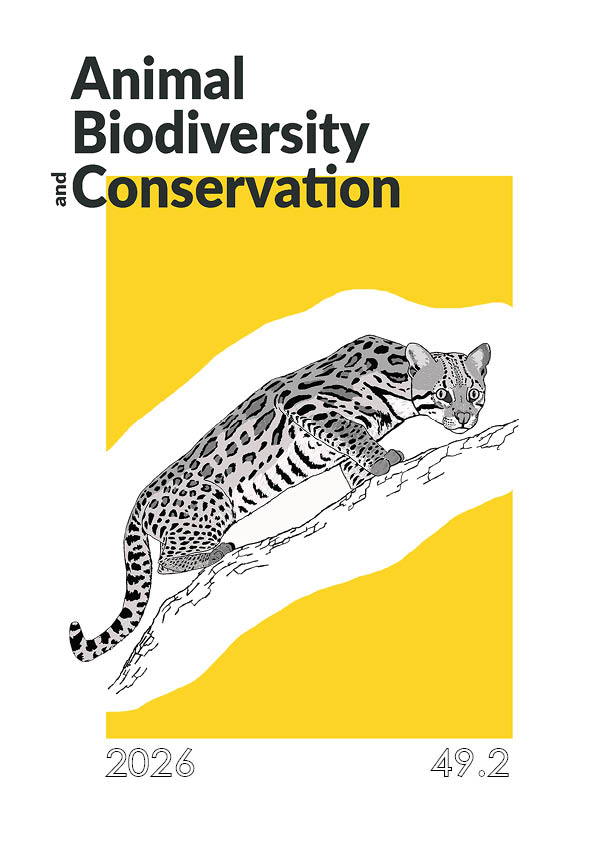

Animal Biodiversity and Conservation. Volum 49.2 (2026) Pàgines: e0019
Vanishing predators: geospatial analysis reveals hidden refuges for threatened felids in Guerrero, Mexico
Flores-Monter, Y. M., Ruíz-Gutiérrez, F., González-Maya, J. F., Chávez, J. C.
DOI: https://doi.org/10.32800/abc.2026.49.0019Descarregar
PDFResum
Guerrero is a critical stronghold for Mexico’s six native felid species (Lynx rufus, Puma concolor, Herpailurus yagouaroundi, Leopardus pardalis, Leopardus wiedii, and Panthera onca), yet a lack of data hinders conservation. This study provides the first multi-species geospatial analysis for this region to identify key environmental drivers and map potential distributions. Using CATPCA and ordinary kriging interpolation, for climate surfaces, and spatially thinned maxnet/ENMeval for species distribution models, we modeled felid presence against topographic, climatic, and vegetation variables. Altitude and precipitation are the most pivotal factors determining distribution, though the specific variables differed across species. The resulting predictive maps identify key regions for targeted field surveys, providing a crucial tool for future conservation planning. Insufficient records precluded a robust model for Lynx rufus.Cita
Flores-Monter, Y. M., Ruíz-Gutiérrez, F., González-Maya, J. F., Chávez, J. C., 2026. Vanishing predators: geospatial analysis reveals hidden refuges for threatened felids in Guerrero, Mexico. Animal Biodiversity and Conservation, 49: e0019, DOI: https://doi.org/10.32800/abc.2026.49.0019-
Data de recepció:
- 14/04/2025
-
Data d'acceptació:
- 25/09/2026
-
Data de publicació:
- 26/10/2026
-
Compartir
-


-
Visites
- 621
-
Descàrregues
- 232