
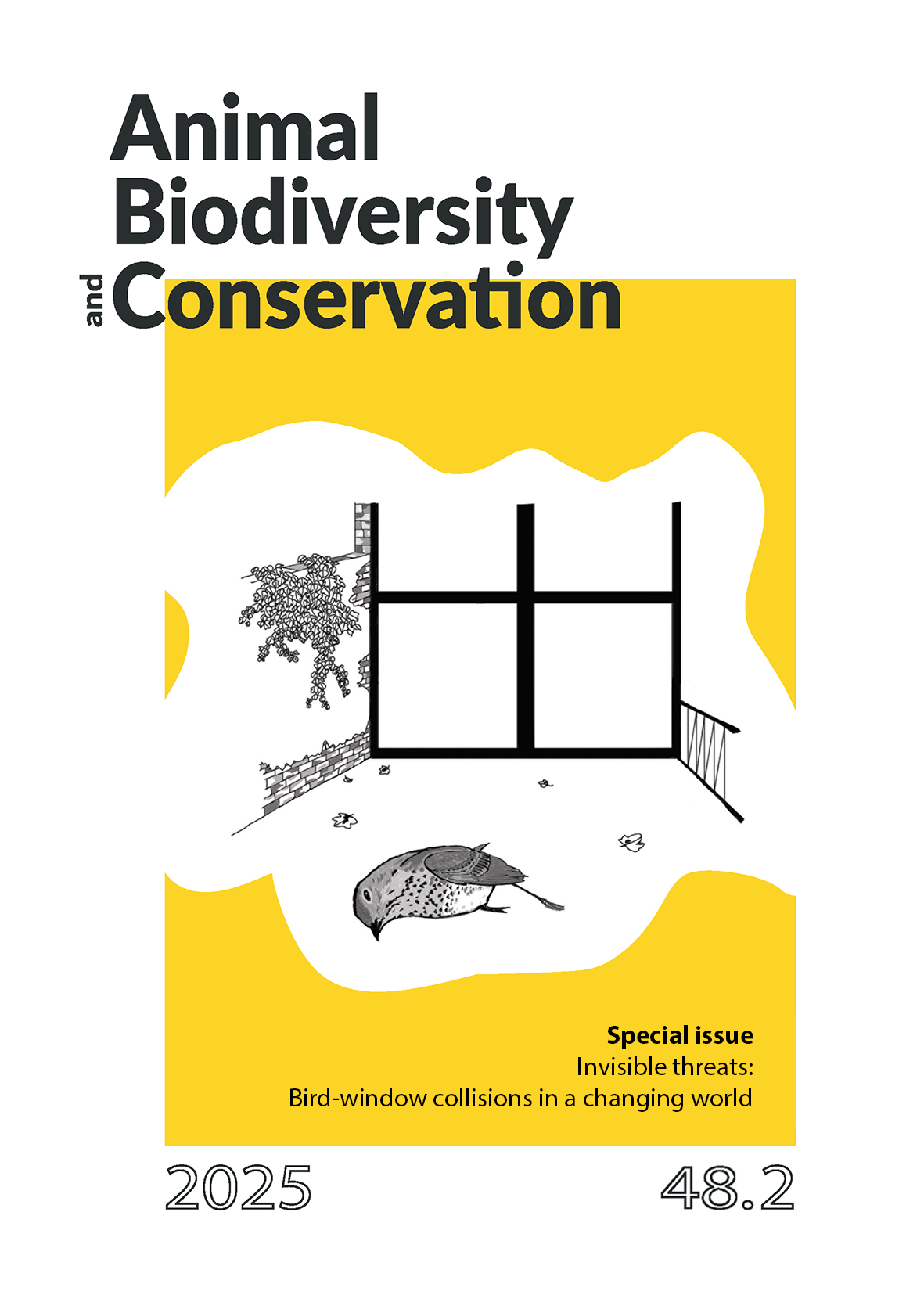

Animal Biodiversity and Conservation. Volum 48.2 (2025) Pages: e0204-
Year-round monitoring reveals that environmental factors largely explain variation in bird-window collisions on a university campus in Brazil
Lee, S. J., Manzoli, E. C., Piratelli, A. J.
DOI: https://doi.org/10.32800/abc.2025.48.0204Download
PDFAbstract
Collisions with glass windows are a significant source of avian mortality, with over one billion birds affected annually in North America alone. However, studies on this subject in Latin America are still scarce, which is worrying for conservation, given that the region has the highest bird diversity in the world. To address this gap, here we investigated bird-window collisions on a university campus in Brazil, assessing which factors are associated with non-random patterns. Collision monitoring was conducted every 2-3 days from November 2022 to November 2023 in Sorocaba, Brazil, through the detection of evidence such as carcasses, injured birds, feather piles, traces of impact (i.e., feathers, body contours, or blood) and third-party information. To identify biological traits and environmental factors that may be potentially related to higher collision frequencies, we obtained biological characteristics of the species involved, as well as the buildings and their surroundings. We used generalized linear mixed models to evaluate the relationships of the biological and environmental variables on the collision frequency. Our results revealed a positive correlation between glass area and collision frequency, underscoring the critical need for preventive measures. This study contributes to advancing the understanding of the issues related to bird-window collisions within Neotropics and calls for public policies and architectural interventions to mitigate these events, promoting the coexistence between urban development and bird conservation.Cite
Lee, S. J., Manzoli, E. C., Piratelli, A. J., 2025. Year-round monitoring reveals that environmental factors largely explain variation in bird-window collisions on a university campus in Brazil. Animal Biodiversity and Conservation, 48: e0204-, DOI: https://doi.org/10.32800/abc.2025.48.0204-
Reception date:
- 15/01/2025
-
Acceptation date:
- 09/12/2025
-
Publication date:
- 22/12/2025
-
Share
-


-
Visits
- 593
-
Downloads
- 482