
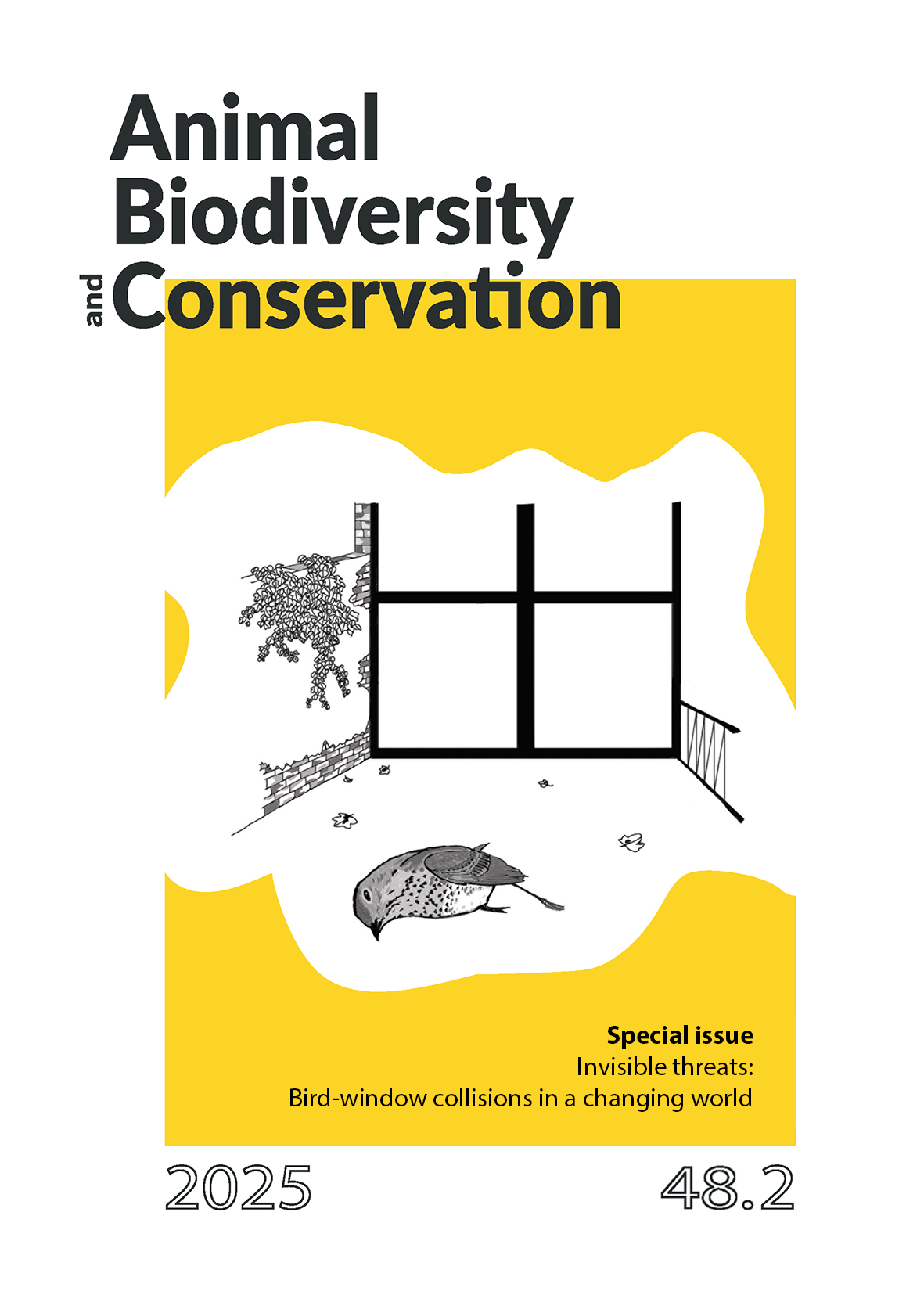

Animal Biodiversity and Conservation. Volum 48.2 (2025) Pages: e0202-
Bird-window collisions: An attempt to inspire and encourage more research and advocacy
Klem Jr., D.
DOI: http://doi.org/10.32800/abc.2025.48.0202Download
PDFAbstract
Clear and reflective sheet glass and plastic in the form of windows are a lethal threat to birds wherever birds and windows coexist. Accounting for birds that survive but later succumb after treatment for their injuries, the most recent estimate of the annual toll windows exact on birds is 1.28 to 3.46 billion in the United States alone, billions more worldwide. Currently most documentation of window fatalities is from North America, but reports of window casualties are increasing markedly around the globe. Uniformly covering existing or new windows with pattern elements separated minimally by 4 inches (10 cm) in vertical columns or by 2 inches (5 cm) in horizontal rows (2 x 4 Rule) will reduce the risk of a bird strike by 95-100 %. Several effective methods are currently available to retrofit existing and novel windows used in remodeling and new construction that transform windows into barriers that birds see and avoid. Tunnel testing to evaluate the effectiveness of bird-window collision deterrent methods has value in testing several prospective techniques in a short period of time, but its limitations make it unsuitable as a standard experimental assessment protocol. Field experiments that provide the most objective data on how a strike deterrent will perform when installed in a human structure is required as a final validating measure of window strike prevention effectiveness. Legislation to protect birds from windows has the most universal promise, but confusion and objection from special interest groups among building professionals make such protection currently unlikely. Relying on building industry professionals to voluntarily act to protect birds from windows in the buildings they construct has only rarely occurred and is not expected to be meaningfully successful for protecting birds everywhere. Several specific research needs are recommended, among others: globally documenting the species killed and injured, studying the details of behavior and the features associated with strikes, their resultant injuries, and the use of the latest methods to reveal the dynamic outcomes for victims. The use of all manner of media to educate, stimulate additional research, and advocacy to protect innocent birds that have no voice or means to protect themselves from this invisible threat is highly recommended. Before it is too late for any individual species or birds in general, collaboration between social and natural scientists is recommended and will be needed to capture a critical mass of the general public to in turn convince all principals capable of acting to save birds from windows.Cite
Klem Jr., D., 2025. Bird-window collisions: An attempt to inspire and encourage more research and advocacy. Animal Biodiversity and Conservation, 48: e0202-, DOI: http://doi.org/10.32800/abc.2025.48.0202-
Reception date:
- 21/01/2025
-
Acceptation date:
- 04/09/2025
-
Publication date:
- 22/12/2025
-
Share
-


-
Visits
- 602
-
Downloads
- 1211